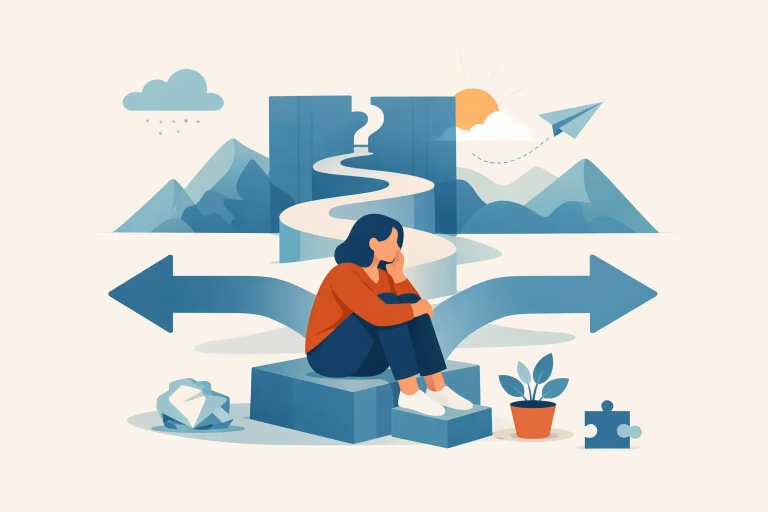

How to Start Counselling Without Pressure
Starting therapy rarely begins with certainty. More often, it begins with a quiet sense that something is not working any more – that you are coping, but only just, or that life feels heavier than it should. If you have been wondering how to start counselling, it can help to know that you do not need to have everything explained neatly before you reach out. You do not need the perfect reason, the perfect words, or a crisis big enough to justify support.
Many people wait longer than they need to because they assume counselling is only for serious breakdowns, or because the process feels unclear and slightly intimidating. That hesitation is understandable. Beginning counselling can stir up questions about cost, trust, timing, and whether talking will really help. A gentler starting point is to treat it less like a big declaration and more like a first conversation.
How to start counselling when you feel unsure
Feeling unsure does not mean you are not ready. In fact, uncertainty is one of the most common reasons people begin. You might know you feel anxious, flat, burnt out, emotionally reactive, disconnected in relationships, or caught in patterns you cannot seem to shift. You might also feel that something is wrong without being able to name it properly.
Counselling can still be useful in that space. You do not need a polished explanation. A good therapist will help you make sense of what feels muddled, rather than expecting you to arrive with a tidy account of your inner life.
Sometimes the hardest part is giving yourself permission. People often minimise their own pain by comparing it to someone else’s. They tell themselves they should be coping better, or that things are not bad enough yet. But counselling is not reserved for the point of collapse. It can be a place to slow down, understand yourself better, and get support before things deepen further.
What counselling is, and what it is not
At its best, counselling offers a steady, confidential space where you can talk openly with someone trained to listen, reflect, and help you understand what is happening beneath the surface. It is not about being judged, fixed, or told how to live. It is also not a performance where you need to say the right thing.
Different therapists work in different ways. Some are more structured, some more exploratory. Some focus strongly on present-day coping, while others help you connect current struggles to earlier experiences, relationships, or trauma. Neither approach is automatically better. It depends on what you need, what feels safe, and what kind of relationship helps you open up.
This is one reason the early stages matter. Counselling is not only about technique. The sense of being met properly, by someone you can gradually trust, often matters just as much.
How to choose the right therapist
When people search for counselling, they can quickly feel overwhelmed by profiles, qualifications, modalities, and unfamiliar terms. It is easy to assume you need to become an expert before making contact. You do not.
A helpful place to begin is with the basics. Look for a qualified therapist who is registered with a recognised professional body such as the BACP in the UK. That gives you some reassurance around training, ethics, and professional standards. From there, pay attention to whether the therapist’s way of speaking feels human to you. Do they seem warm, clear, and grounded? Do they work with the kinds of difficulties you are facing? Do they explain things in a way that calms rather than confuses?
Practical details matter too. Online counselling can make support more accessible, especially if travel, work, caring responsibilities, or privacy are concerns. For some people, being in their own space helps them talk more freely. For others, face-to-face work feels more containing. There is no universal answer here.
Cost also matters, and it is worth being honest with yourself about what is sustainable. Weekly sessions are common, but affordability should not be treated as an afterthought. Some therapists offer concession spaces, and it is reasonable to ask.
Making first contact without overthinking it
One of the biggest barriers is not counselling itself. It is sending the first message.
People often worry they need to write something detailed and articulate. Usually, a simple message is enough. You might say that you are looking for support, mention one or two things you are struggling with, and ask about availability. That is plenty.
You do not need to tell your whole story by email. In fact, many people prefer not to. The first contact is simply a way of opening the door.
If a therapist offers an initial call or consultation, it can be a useful next step. This is not an exam, and you are not committing yourself for months. It is a chance to get a feel for the therapist, ask practical questions, and notice how you feel in the exchange. Do you feel rushed? Talked over? Slightly more settled? Those reactions matter.
At The Psychological Oasis, this early stage is approached gently, because beginning therapy can feel vulnerable enough without adding unnecessary formality. For many people, a calm, human response makes it easier to take the next step.
What to expect from your first session
The first session is often simpler than people fear. You will usually spend some time talking about what has brought you there, what you hope for, and any questions or worries you have. You may also be asked about relevant background, such as recent stresses, important relationships, or previous therapy.
That said, a first session should not feel like an interrogation. Some structure is helpful, but there is a difference between gathering information and overwhelming someone who is already feeling exposed. You should be allowed to arrive as you are, at your own pace.
It can help to expect mixed feelings afterwards. Relief and vulnerability often sit side by side. Some people feel lighter. Others feel emotionally stirred up, especially if they have spoken honestly about things they usually hold in. Neither response means counselling is or is not working. It simply means something real has begun.
Questions worth asking before you begin
If you are wondering how to start counselling in a way that feels safer, asking a few clear questions can help. You might want to know how the therapist works, whether sessions are online or in person, what their fees are, how confidentiality is handled, and whether they have experience with the issues you want to bring.
You can also ask what happens if you are not sure after the first session. A thoughtful therapist will understand that fit matters, and that trust takes time. Good counselling is collaborative. You should not feel trapped into continuing if something does not feel right.
At the same time, it helps to be realistic about the early stages. A perfect feeling of certainty is rare. Sometimes the question is not “Do I feel instantly comfortable?” but “Do I feel safe enough to keep exploring?” There is a difference.
When counselling feels hard to start
There are moments when counselling can feel especially difficult to begin. Shame can make people hide addiction, trauma, low self-worth, or relationship patterns they fear will be judged. Burnout can leave people too depleted to research options or send a message. Anxiety can turn every small decision into a spiral.
If that sounds familiar, try making the process smaller. You do not need to solve the whole journey today. You only need one manageable next step. That might be noting down what you want help with, shortlisting one or two therapists, or sending a brief enquiry.
If speaking openly feels hard, say that too. You are allowed to begin with “I’m not sure how to talk about this yet.” That is already honest, and honesty is enough.
Starting at your own pace
Counselling does not ask you to become someone else before you begin. It meets you where you are – uncertain, tired, hopeful, guarded, or all of those at once. The process tends to work best when it feels steady rather than forced.
If you have been thinking about reaching out, you do not need to wait until you are in pieces. Support can begin earlier, more quietly, and with less pressure than many people expect. Sometimes how to start counselling comes down to allowing one simple truth: you do not have to carry everything on your own, and you are allowed to ask for help in a way that feels gentle enough to bear.